Introduction
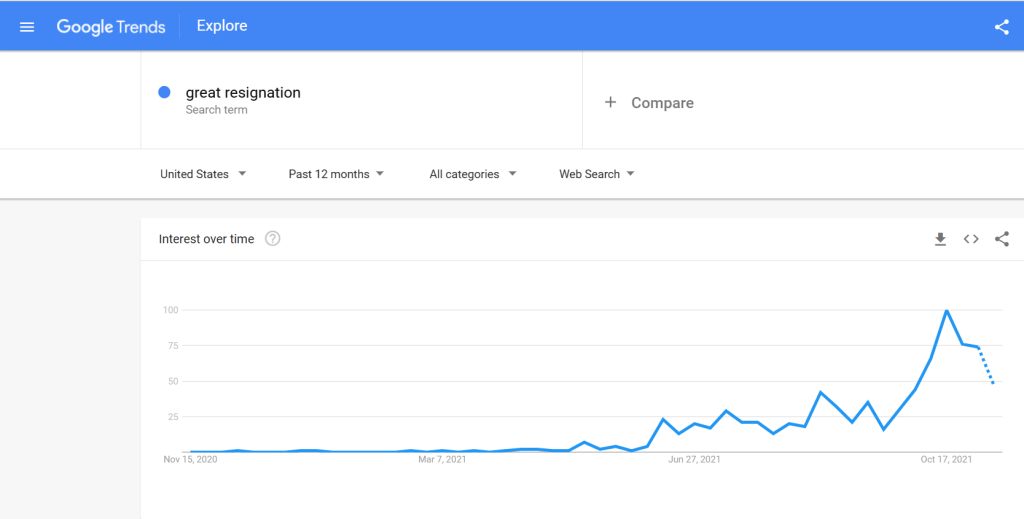
The phrase the great resignation is quite catchy. It is so catchy that you’d be surprised to know that that this term was not of great interest until about five months ago, back in the week of June 13. Per Google, very few people searched for the word at a meaningful rate until that week. Since then, the great resignation skyrocketed to its highest relevancy in late October. That’s what led me to wonder if this is truly a movement or some viral headline spreading through the web like wildfire? Fortune Analytics and the Future Forum, a consortium backed by Slack, surveyed over 10,000 knowledge workers worldwide to see what is happening in this workforce sector. Knowledge workers are those who do not use physical labor to work.
The data from this report was so interesting (and relevant) that I wanted to take the time, even though it’s not directly related to accounting, to share this information. There are five key takeaways from the report that I think anyone reading this should consider whether you’re an employee or an employer:
- Workers who can work remotely want to work from home more than working at the office.
- Employees feel like they don’t have a voice when making post-pandemic policies.
- Employees want to work at any time of the day versus the traditional 9 to 5.
- Employees don’t feel that their employers are transparent. Employers do.
- 57% of employees are looking for a new job within the following year.
I want to preface this by saying that this is one survey and that there are potentially other surveys that may contradict this one, so take this information for what it’s worth. However, 10,000 is also a lot of workers to get information from, so I feel comfortable enough to share it. Let’s get into the major trends of the report.
Employees want to work from home. Employers do not.
While we’re on the topic of phrases with the word great, there is a “great divide” between what executives and employees want. According to the Pulse Report, only 17% of non-executives wish to work at the office every day. Compare this to 44% of the executives who want to return to the office full-time. This report attributes the discrepancy coming from employees and executives having different experiences within the workplace. Executives generally have more access to office resources, are required to communicate with each other more frequently, and have a higher sense of belonging. They are making a difference within the Company that the executive can objectively see.
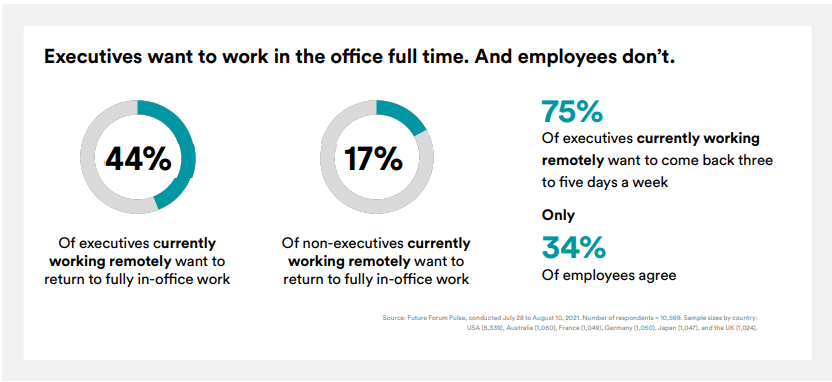
On the other hand, employees are reporting higher stress levels when reporting back to the office because of a lower sense of work-life balance commuting to the office. This point is interesting as one can argue that working from home can easily blur the lines between how long you’re taking on projects versus taking time off. Nevertheless, the survey highlights commuting as a significant reason. When asked whether having a hybrid is more feasible, executives overwhelmingly (75%) want to work three to five days a week at the office. In contrast, only 34% of employees agree that their Company should implement some hybrid. As we can see, executives want to be at the office overwhelmingly more, whether full-time (44%) or part-time (75%). Employees show more reservation on this front as 17% and 34% want to work full time and part-time, respectively.
Employers are planning a return to the office without Employee consideration
Despite the data showing apparent differences between executives and employees, executives have not adequately involved employees in the post-pandemic return to work plans. According to the report, 66% of executives reported that post-pandemic planning conversations primarily occur at the executive level. There is little to no direct input from employees or consideration of their preferences. The report does not go into much detail about why this is. Nevertheless, considering the great divide between workplace preferences, the executives’ decisions to mandate office work drive candidates and current employees away from that job. Decision-makers must decide how to balance the remote work because the lack of interaction between employees also drives down office morale. Also, the lack of physical presence makes it harder to communicate and coordinate tasks. However, this article suggests that employees should have more say or have executives receive opinions from the employees if they are not already doing so. If they do not, then they run the risk of increasing the feeling for the next topic.
Employees are not feeling authenticity from management
The data suggests the conflict between the motivation behind executives and non-executives to return to work is driving the feeling of inauthenticity. Executives believe that the office is a better place to work than from home because there is a dedicated space to focus; employees are more focused on connecting with other coworkers and clients as the reason to return. Therefore, it seems that the messaging from the executives is not aligning with the employee’s values.
Another area that employees focus on is the transparency of the workplace of the future. According to the survey, 66% of executives believe that they show transparency about the post-pandemic remote-working policies. 42% of employees agree with this statement. This statistic is not too alarming. Many news sources have revealed companies promising to allow employees to work from home and then reverse their stance months later or penalize their employees for staying remote. One of the more famous stories about this comes from the employees at Alphabet Inc. According to Reuters, Alphabet’s Google is cutting pay for employees who work from home and live in an area with a reduced cost of living from the home office. One example shows that a Google employee received a pay cut as high as 25% for living in Lake Tahoe and not working in San Francisco. Alphabet is not the only large corporation that is contemplating this. Facebook, Twitter, and other big tech companies are also known for enforcing pay over where you are geographically working. On the other side of the spectrum, Reddit has declared that there will be one salary based on whether you are a part of the New York or San Francisco office. This policy has been effective since October 2020. As we can see, there is a lot of confusion and back and forth between companies and employees about where they need to work and how they are getting compensated. The uncertainty in a corporation’s post-pandemic plans drives the employee’s feeling of management not being fully transparent with their employees.
Employees want flexibility on when and where to work
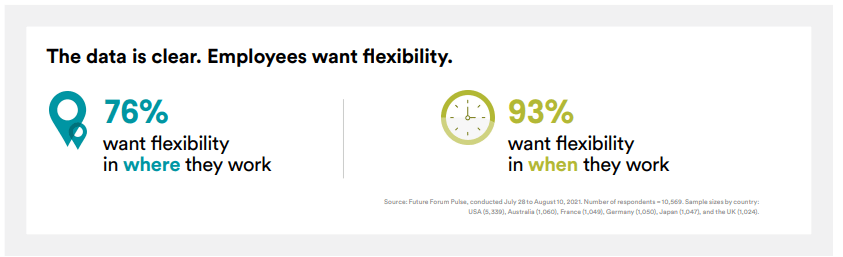
While decision-makers are busy finding the optimal balance in the plan to return to the office, employees are fighting employers to work where they want and when during the day. In the latest pulse survey, 76% of workers want flexibility in where they work. An overwhelmingly 93% want flexibility when they work. Employees currently allowed those two policies are twice as likely to report an improved work-related stress level. This survey response is compared to those working the standard “9-5” in an office.
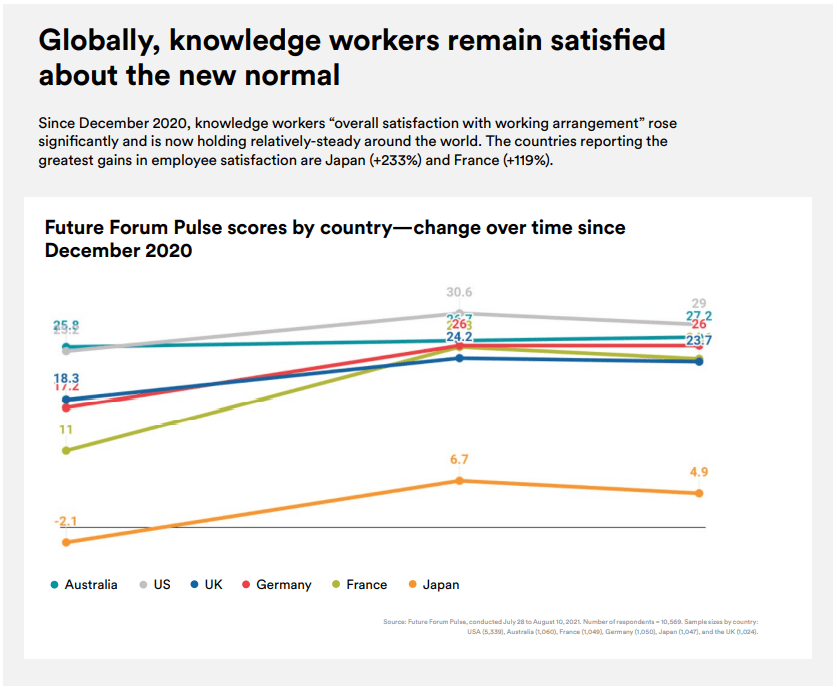
Furthermore, the data suggest that employees reported higher overall satisfaction with the new working environment as time in the virtual world increased. Future forum conducted a poll in December 2020 to see, by country, the level of satisfaction with working remotely. Two subsequent studies in July and August were done in 2021 to determine if there was an improvement or decline in overall satisfaction. What the survey found was that there was an increased satisfaction with the working environment, with the base satisfaction ranging from 11 (indifferent) to 25 (positive), centering out to around 25 (positive) in August 2021 for all countries except Japan. What this shows is that there is an adaptation to the new working environment. Now, there is hesitancy for those who have adapted to return to the workplace. The statistics show that employees do not want to return to the office and instead prefer to work when and where they can also fit their personal needs.
Employees are looking for the Company that best fits their values
All these points mentioned before add up to this final section. Unheard employees who are forced to go back to the office, feeling management’s inauthenticity and an unwillingness to accommodate them lead employees to either look for other jobs or exit the workforce altogether. Whether or not you think this trend is sustainable is not the point of this post. However, the future forum poll survey shows that 57% of all respondents report that they’re open to looking for new jobs in the next year. 63% of Americans lead the polls, with Australia not too far behind at 60%. Of the reasons mentioned for leaving, low satisfaction on the current flexibility of their job rose at the top (71% said they are open to new opportunities for this reason).
In comparison, 72% of workers say they will make the job switch if they have a low sense of belonging. This dual dilemma, in my opinion, is the difficulty that executives have to make within their workforce. On the one hand, if the companies don’t incorporate office work, the total team morale will decrease. If companies include too much work from the office, employees will feel that they do not have enough flexibility. This is truly one of the most challenging times for executives, and they will need to come to some compromise to satisfy both the needs of the corporation and the needs of the employees.
Final thoughts and conclusions
We are truly living in an unprecedented time where both corporations and employees need to come together to find a balancing act between work and life. As work becomes more of a digital and mentally demanding job and less of a physical one, employees are not tied down to one geographic location to do their job. There needs to be a culture maintained within the Company that traditionally was kept in place by the small breaks during work. Employers are encouraged to listen to the needs of their workers while also setting realistic expectations for their employees. Employees need to continue to prove that working from home is as effective as working from an office and take ownership in your work to keep the trust growing. I treat this new work environment to when employers first gave you tasks with minimal consequences and then, over time, gradually gave you more responsibility. It takes trust to enter a new work environment. Companies that trust their employees have embraced work from home based on my experience. Over time, other companies should follow if they have the same sentiment.
The opinions expressed herein are my own and do not represent my employer’s views in any way. Nothing posted here should be considered official or sanctioned by my employer or any other organization I’m affiliated with.
 Students, Accountants, and Business Owners (SAB)