Entrenched inflation is the idea that, as prices or costs rise, they become fixed (or entrenched) into the product or service pricing for the long term. As a result, businesses and other decision-makers begin to factor in the increased cost within their forecasts and business models, eventually passing on the cost to consumers through price increases. Once this happens, it becomes hard to bring prices down lower.
A typical example of inflation becoming entrenched are price wages. Imagine an employer providing raises to their employees as an adjustment to the cost of living. It will become difficult to convince employees that their pay needs to decrease without lowering their morale or having your best employees jump ship. With the unemployment rate so low and so many jobs available, the inflationary pressures from wage growth have become a monster that feeds upon itself.
This pressure is why the Fed’s resolve is to combat inflation. Combat inflation before the inflation forces feed itself. Although recent market data show inflation slowing, it is still high. The Fed’s main concern is that the inflationary data will stay at 8% due to the nature of the inflationary pressures. As Powell said, “The burdens of high inflation fall heaviest on those who are least able to bear them.” So, hopefully, the fight against inflation will be short and have low pain on everyone.
Jerome Powell finally stood his ground on the Fed’s policy position at this past week’s Jackson Hole Symposium. We could argue that he has been reiterating his goal to combat inflation over sustaining a strong market since the prior quarter. However, there was a much stronger tone in his Jackson Hole Speech this time around. A speech that was concise and left little to the imagination. Compare this to the published federal minutes and rate decision meetings, where he started his speech hawkish but left dovish tones during the Q&A section. The overall message of last Friday’s speech was as follows:
Price Stability is the number one focus.
The Federal Reserve is aware that the cost of bringing down inflation means causing “pain” for everyone, but it is something they must do.
Inflation must be combatted “unconditionally” until the job is completed.
As a result of this hawkish message, it became painfully clear that the market, at least in the short-term, understood the message this time. During the speech, all three major indices made a failed attempt at another rally. The market responded with a crash to the downside after what I believe to be essential points, Powell’s remarks:
“While higher interest rates, slower growth, and softer labor market conditions will bring down inflation, they will also bring some pain to households and businesses. These are the unfortunate costs of reducing inflation. But a failure to restore price stability would mean far greater pain.”
“Our decision at the September meeting will depend on the totality of the incoming data and the evolving outlook. At some point, as the stance of monetary policy tightens further, it likely will become appropriate to slow the pace of increases.”
“Our responsibility to deliver price stability is unconditional.”
As of the close, the Nasdaq was down over 4%, S&P 500 down 3%, DOW Jones 3%, and Russell 2000 3%. Within the past month, we’ve seen tremendous comebacks from such market drops. However, with liquidity picking up in the next couple of weeks and a much stronger tone from the Federal Reserve, do we see a new downtrend reemerging? Only time will tell. Market data heavily drive interest rate decisions. If we see continued inflationary pressures declining as we’ve seen with the PCE and PCI, perhaps the Fed’s tone will change. Until then, I’m seeing the market as getting a “reality check” that the Federal Reserve does not have the market’s back this time as they did for the past 15 years.
Once the inventory count personnel have received the instructions and understand the procedures, the Company will begin with the inventory count. As we saw in the previous blog, the counters are assigned locations and specific inventory to count. However, how do counters know which items are still leftover to record in their books? How do the reviewers overseeing the counters know which boxes of inventory were considered in that count?
The answer is that the Company places tags over the counted items. By doing this, the Company mitigates the risk that individual counters:
Double-counted an inventory item
Forgot to include an inventory item
Appropriately excluded a non-inventroy item
What does an inventory Tag Look Like?
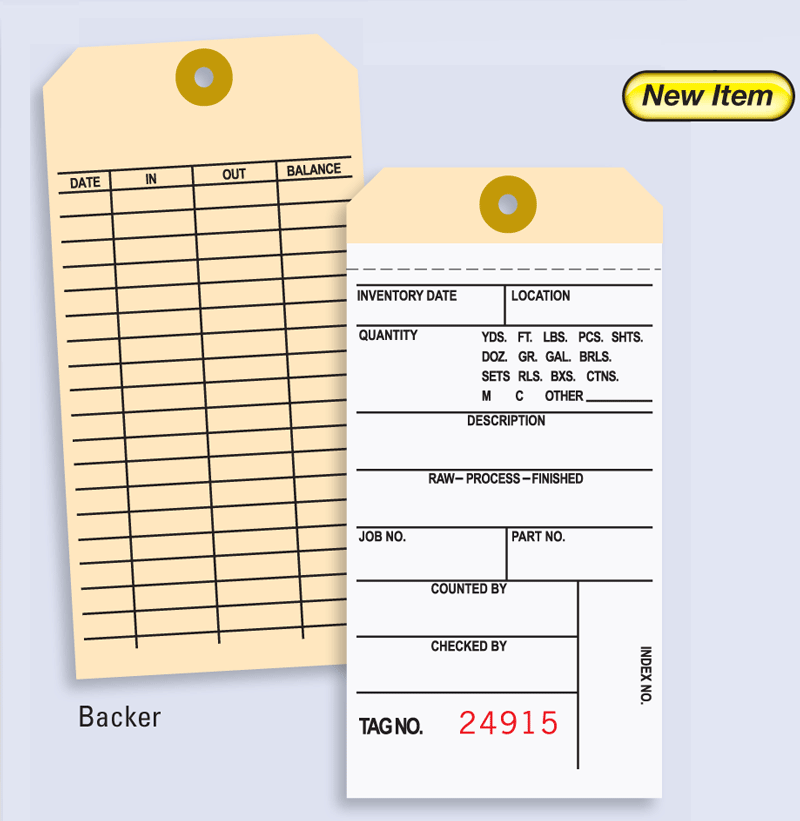
I have included a graphic that shows what an inventory tag could look like. Keep in mind that keeping track of tags varies from Company to Company. Furthermore, companies are starting to embrace more digital methods of tagging their inventory since the cost to benefit is improving. Also, more senior team members are growing trusting of technology. But, manual tagging is standard even in the most advanced businesses in Silicon Valley. However, the purpose of these tags remains the same.
Illustration 1: Tag Control (Physical) (Credits: Print4Less. In no way am I affiliated with them or encouraging you to buy from them. They simply have a standard inventory tag.)
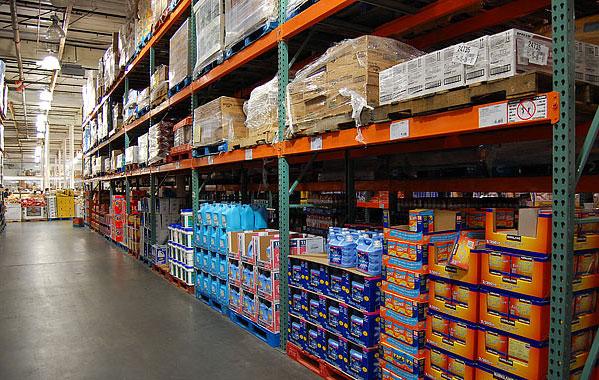
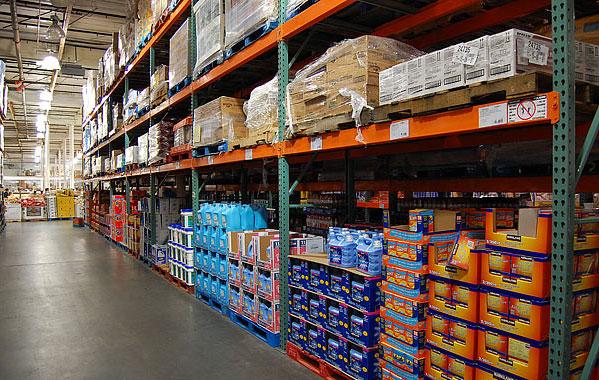
I have typically seen companies place tags over each item, the box if the parts are small and grouped, or on the shelves that they consider inventoriable (i.e., the Company intends to sell to customers or clients) before starting the inventory count. Tagging items is essential in companies that mix their supplies with the things they will sell. One example of this is Costco.
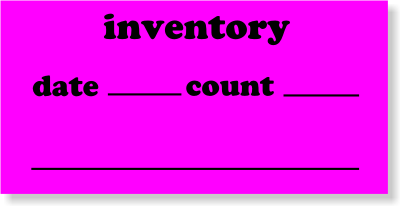
Illustration 2: Simple Inventory Tag. The control tag doesn’t have to be standard but it should be able to let you know that inventory was counted and how much.
Although their primary business is to sell items from their warehouse, some of their merchandise is used internally for the Company or as a demonstration (“Demo”) item to market to potential buyers walking through the warehouse. Since their store is essentially one big warehouse, they don’t have much room to store non-inventoriable items apart from placing them on top shelves of their store. That’s why you see some boxes, as your shopping, marked with the words DNI (“Do Not Inventory”). Costco doesn’t intend to sell those items. Again, the reasons can be as follows (also, not limited to these reasons):
Marketing a sellable version of a product
Use the items internally (e.g., Using a vacuum cleaner that they currently sell to clean up their facility)
Some defect that makes them unsaleable
The articles have been written off or will be sent back to the supplier
The Inventory Tags must be Sequential
Another important consideration when using inventory count tags is that every single tag should be accounted for. All tags are numbered sequentially for a fundamental purpose. Suppose there is a missing tag. That raises alarms as to whether someone stole an inventory item. Or it is purposefully being omitted from the Company or auditors. That is why it is imperative to keep a record of every single tag control that you have, whether you are using it or not. Common reasons for not using a tag is if:
There is a mistake on the tag
The company voided the tag and replaced with a new one
The tag is damaged and not readable
If there is no reasonable answer to a missing tag, that should be concerning as a business owner.
Final Thoughts
I want to clarify that the objective of inventory tags is different from the barcodes found within each product item. A company may have an inventory tracking system using the barcode as that represents the SKU number. However, the quantity within the system is not always accurate due to human error and theft. For example, store clerks are notorious for scanning one item multiple times to cut the extra work in manually scanning each item. The scanner doesn’t realize that sometimes the object is the same, but the description of each item is slightly different. For example, someone could be checking out ten of the same item, but all are different colors. Suppose you scan only one color ten times. In that case, each item’s final inventory could result in a misstatement (i.e., the final stock of the red product can be understated by nine while all other nine colors are overstated by 1). This is why the inventory tag control should be different from the SKU item records in the inventory management system. We’re trying to get the accurate number as of a specific date and see if it aligns with what is currently inside the system for each color (assuming the Company organizes inventory by color). After marking the final stock quantity within the tag control, the final number must be recorded within the count sheet.
Inventory is one of the essential parts of a company’s balance sheet if you are selling goods. Companies create and sell their product to their customers using them. Therefore, business owners should count their products to see how much inventory they have at least once a year. Is there an exact way to go forth with inventory counts? Not necessarily. However, there are best practices companies can use to ensure that they accurately represent their total inventory by the end of their count.
The most common items needed for an inventory count consists of the following:
Count Instructions
Tag Controls (or electronic equivalent)
Count Sheets (or electronic equivalent)
In today’s post, we’ll go over the most common components of the count instructions and why they are needed. Let’s dive right in.
Count Instructions
Before the inventory count begins, management and the ones who will be executing the inventory count must align with the purpose and how to perform the inventory count. Instructions typically include the following:
When the inventory count will take place
Which inventory locations are in scope (i.e., which inventory sites and specific areas of a warehouse if the count is a cycle count)
Who will be responsible for counting inventory, reviewing the variances, and signing off as the second reviewer
How to record inventory on the count sheet
Whether the count is blind or not
These instructions are the most crucial part of the inventory count, in my opinion. Suppose the executors are not performing the inventory count correctly. Then, the integrity of the count is compromised. There’s a higher chance that the workers didn’t count the inventory accurately, collusion has taken place to conceal inventory theft, or someone inappropriately recorded merchandise (i.e., counted supplies or items that the company has no intention to sell to customers). Therefore, management should invest more time to ensure everybody is on the same page before starting with the inventory count.
When the Inventory Count Will Take Place
This part sounds like any common sense communication topic. However, it is not unheard of for the counters to have the inventory count date, but the sales team and logistics do not. I have attended complete inventory counts where forklifts are moving inventory around to fulfill a shipment because sales teams, not knowing there was a count in progress, wanted cargo to go out. So, each relevant department must be notified when the inventory count will take place. If there is any movement in goods, then, as we mentioned before, there’s a risk that the inventory count will need to be re-performed or the final results are inaccurate.
In-scope Inventory Locations
If you have ever done an inventory count, you appreciate how much time this process takes and how disruptive it is for businesses. Therefore, most companies do not perform an inventory count for their entire business in one day. If they perform a cycle count, the instructions need to be clear about which sections to count. The company may inadvertently transfer in-scope inventory and confuse the counters and the auditors if there is no proper communication. If there is a full inventory count, most companies stagger the count date for each location to fulfill customers’ needs while the others pause their operations in the allotted time.
Assigning Responsibilities
It is essential to specify who will count, supervise, and review the final variances towards the end of the count. Generally speaking, you don’t want a reviewer also to count as this can cause a self-review conflict. The counter should also know about the product they are counting to understand how to measure the item, such as whether they are in units of thousands, one single unit, gallons, tonnes, etc. Also, the counter shouldn’t count the items they are directly responsible for, as this can cause a self-interest conflict. The supervisor should also not be involved in the area that they use daily for the same reason.
How to Record Inventory on the Count Sheet
This section is mainly for companies that still use paper count sheets. Most electronic count systems now have audit trails that show modifications in the count. It is generally a best practice for alterations to a manual count sheet to be recorded with a strikethrough of the old value and the new value right next to the strikethrough. I have also seen counters put their initials next to the new value to show that they are the ones who modified the entry. In summary, showing how each item is recorded and proof of modification are the main goals of recording on a count sheet.
Blind Count versus Non-Blind Count
All the inventory accounts that I have been a part of consisted of a blind inventory account. Blind count means that the counter has no quantity disclosed to them before and during the count. This is important because if the counter knows how many items to look for, they can figure out a way to match that number and show that there is no inventory missing or a surplus. The employee can pocket the difference or can use it as a cover-up for someone else’s theft. As with any business, robbery does happen to a company, so there must be no tip to encourage cover-ups.
Final Thoughts
I briefly covered the most common parts of the inventory instructions and why they are essential. Companies may discuss other components in the instructions. However, these should be standard in public companies and within privates that have established processes. In the following sections, we will discuss other inventory count areas, such as the purpose of the tag controls and count sheets. Hopefully, by understanding the core components of an inventory count, the inventory count can go smoothly and align the auditor and counter.
The opinions expressed herein are my own and do not represent my employer’s views in any way. Nothing posted here should be considered official or sanctioned by my employer or any other organization I’m affiliated with.
Continuing with the statement of cash flows, looking at the Company’s operating, investing, and financing activities can tell you a lot about the health of a company. Starting with operating activities, you can see whether the Company can generate cash with its core operations. Investing activities shows how the Company uses their cash float to grow their business. Financing activities showcase the Company’s dependence on external sources of cash to fund the Company’s objectives. Individually, the movements in one activity do not necessarily indicate a good or bad situation. Evaluate these activities in the aggregate (i.e., operating, investing, and financing) to determine whether a company is doing well or trying to stay afloat. In today’s blog, let’s go over each component of the statement of cash flows at a high level to describe how these activities influence one another.
What does the operating cash inflow (outflow) tell you about the health of the business?
Generally speaking, a positive cash inflow from the business’ operating activities tells you that the Company can generate cash from its normal operations without the help of external sources of funding. This cash flow assumption continues if straight quarters or years of cash inflow from operating activities. In a word, the Company is considered “self-sustaining” from its core operations. If there is an inflow, the Company can use the money for other business areas, such as new equipment, investments, or other companies via an acquisition.
If the operating cash has an outflow, the Company spends more money to keep its operations running than receiving money. If this happens occasionally, it’s not necessarily a bad thing. It could be as simple as there may be a difference in the timing of receiving cash or paying out to vendors. Often, this situation occurs with a company that is recently about to reach profitability. However, if this outflow is consistent quarterly or annually, it indicates that the Company has a problem with its operations. Common reasons for the cash burn are high operating expenses. For example, a company is spending too much on advertising or not receiving enough return on investment to justify its marketing method. Salaries could be too high, or it costs too much to have the current sales and research team because there are not enough sales generated. Overhead is another common issue because there is too large of a finance team or insufficient utilization of the Company’s assets (i.e., buildings, machinery, etc.) to create products or services. The Company could also be spending too much on inventory that isn’t selling at a high enough price (e.g., the margins are too low). These explanations are not an inclusive list. However, I am highlighting an issue with the Company’s core operations, and it boils down to how the Company uses its cash daily.
There may be times when there is a mismatch between the income statement and operating activities of the cash flows within a period, such as having a positive net income and a negative cash outflow. Or, there may be a net loss and a positive cash inflow. The first scenario may indicate that the Company has received a temporary gain or temporary increase in revenue. But, their core operations are still not sustainable. In the second situation, the Company may have too many non-cash expenses, which may indicate a difference in timing or mean that it invests too much in assets and is not generating enough return on investments. A typical example of this is when a company has too many long-lived assets. Depreciation expense for the assets are significant on the income statement and is high enough to offset revenue significantly, showing a net loss. The investments are not generating enough return to justify their purchase. The Company is investing too much into assets when they could use the money elsewhere, such as on marketing or a better sales team. On the cash flow statement, however, the Company receives cash because, when removing the asset’s depreciation, the actual expenditures are not more than their cash acquired through their operations.
Another example of a discrepancy between the net income and operating activities is when a company decides to delay the payments to their vendors. The Company may be recording a net loss on their income statement since the expense still needs to be incurred in the current period. However, it will record a net gain in cash flows since they did not pay their vendors in the same period. Therefore, this is a difference in timing. Investors should be cautious of this timing difference to pay vendors later because this can indicate that the Company needs to retain cash. It means they have trouble keeping their business afloat. This situation may be misleading, so it’s essential to understand why the operating activities records show discrepancies in the income statement.
What does the investing cash inflow (outflow) tell you about the health of the business?
Generally speaking, if the Company is self-sustaining, i.e., its operating activities show a consistent cash inflow, it is normal for a company to invest its cash into either more assets or securities to generate more money in the future. Therefore, it would be a healthy sign to see cash outflows in the investing activities when there is a positive inflow from operating activities.
However, it would be a red flag if the Company showed a cash outflow from investing activities and the operating section. The reason is that a regular company would not lock their cash into illiquid assets if they are losing money and would instead be choosing to enter a state of cash preservation. However, it is common to see companies invest their excess cash into stable liquid securities such as treasuries to generate some yield when in a cash conservation mode. However, if they are still investing activities into new assets, this may indicate that the business structure or industry forces the Company to invest in keeping the business competitive.
A typical example of this happening is within the airline industry. The airport terminals, airplanes, and machines used to maintain their planes require a high expense to keep up with regulations and quality standards. Even if the Company is pouring cash out of their operating activities, they still need to continue to invest in the latest technologies and maintenance since airplanes are delicate and the industry is highly competitive. If they don’t, airlines run the risk of having one of their airplanes malfunctioning and thus would cause a more significant problem not maintaining their equipment. Therefore, airlines are constantly buying new equipment and machinery to keep the operations running, even if the Company is losing money because of a lack of flights or demand.
What does the financing cash inflow (outflow) tell you about the health of the business?
You start to see a trend about when a cash inflow or outflow is suitable for a company. When the Company receives positive cash flow from operating activities, the cash inflow from financing activities is generally a healthy sign. Companies will typically try to expand their operations or provide greater returns for their investors when they do well. However, companies don’t always have the free cash flow to expand their operations or buy back shares from their investors. Or, a company may have the cash to expand their operations but find that they can use their money on hand in case there better opportunities down the road. Companies will take on debt or issue shares to fund their strategy to solve this situation. Again, this is okay if the Company is generating positive cash inflows from operating activities because the assumption is that it can back its debt. If the Company is issuing stock, the assumption is that the proceeds can provide more return on the investors’ money by investing in more assets to generate higher revenue.
The danger of a company taking on more debt or selling more shares to investors when the business is not self-sustaining because now it implies that the Company is asking for money to keep its operations afloat (i.e., not go out of business). Is this such a bad thing, though? The answer is it depends. This investor outreach situation is quite common in the industry that I audit, which is biotech. Many venture capitalists invest in these start-up biotech companies hoping that one of these companies will reach FDA approval and sell their products exclusively to recover the losses incurred during their research and development phase. However, the Company will need to raise funds periodically to keep its dream alive. So it’s pretty common to see in the cash flow statements an increase in cash inflows from financing activities while the operating activities are bleeding cash. However, this is not always the case with other industries as there may not be interest to keep a struggling operation afloat since there is nothing novel or exclusive to sell in the future. This scenario is why it’s common for venture capitalists to invest in tech but maybe more reluctant to keep a heavy cash outflow company in another industry that’s well established and unlikely to have disruptions in technology, such as a company involved in aviation.
The opinions expressed herein are my own and do not represent my employer’s views in any way. Nothing posted here should be considered official or sanctioned by my employer or any other organization I’m affiliated with.
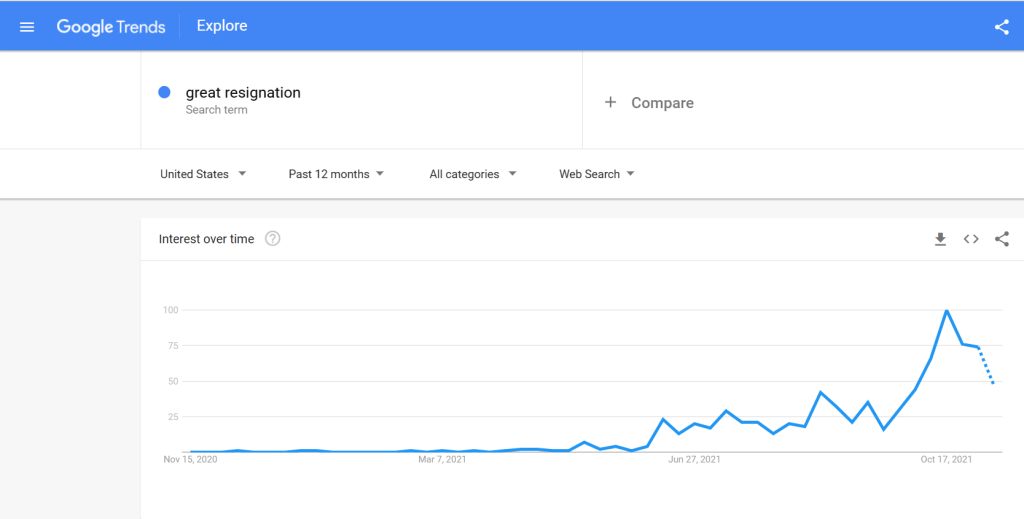
The phrase the great resignation is quite catchy. It is so catchy that you’d be surprised to know that that this term was not of great interest until about five months ago, back in the week of June 13. Per Google, very few people searched for the word at a meaningful rate until that week. Since then, the great resignation skyrocketed to its highest relevancy in late October. That’s what led me to wonder if this is truly a movement or some viral headline spreading through the web like wildfire? Fortune Analytics and the Future Forum, a consortium backed by Slack, surveyed over 10,000 knowledge workers worldwide to see what is happening in this workforce sector. Knowledge workers are those who do not use physical labor to work.
The Great Resignation All-Time Search Relevancy (Source: Google Trends)
The data from this report was so interesting (and relevant) that I wanted to take the time, even though it’s not directly related to accounting, to share this information. There are five key takeaways from the report that I think anyone reading this should consider whether you’re an employee or an employer:
Workers who can work remotely want to work from home more than working at the office.
Employees feel like they don’t have a voice when making post-pandemic policies.
Employees want to work at any time of the day versus the traditional 9 to 5.
Employees don’t feel that their employers are transparent. Employers do.
57% of employees are looking for a new job within the following year.
I want to preface this by saying that this is one survey and that there are potentially other surveys that may contradict this one, so take this information for what it’s worth. However, 10,000 is also a lot of workers to get information from, so I feel comfortable enough to share it. Let’s get into the major trends of the report.
Employees want to work from home. Employers do not.
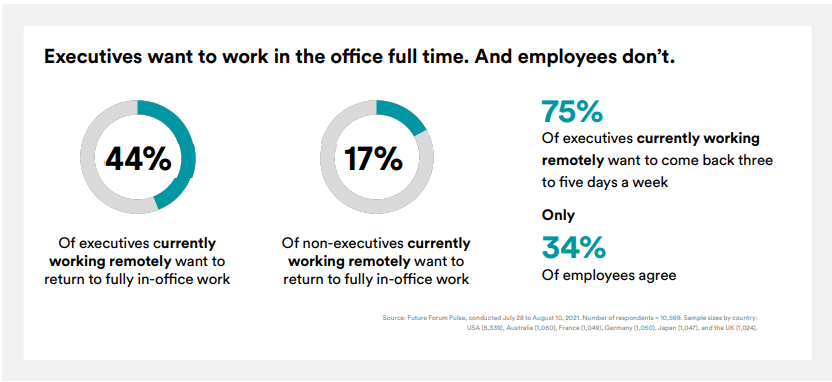
While we’re on the topic of phrases with the word great, there is a “great divide” between what executives and employees want. According to the Pulse Report, only 17% of non-executives wish to work at the office every day. Compare this to 44% of the executives who want to return to the office full-time. This report attributes the discrepancy coming from employees and executives having different experiences within the workplace. Executives generally have more access to office resources, are required to communicate with each other more frequently, and have a higher sense of belonging. They are making a difference within the Company that the executive can objectively see.
Chart comparing executives and employees desire to return to the office (Source: Future Forum Pulse Survey)
On the other hand, employees are reporting higher stress levels when reporting back to the office because of a lower sense of work-life balance commuting to the office. This point is interesting as one can argue that working from home can easily blur the lines between how long you’re taking on projects versus taking time off. Nevertheless, the survey highlights commuting as a significant reason. When asked whether having a hybrid is more feasible, executives overwhelmingly (75%) want to work three to five days a week at the office. In contrast, only 34% of employees agree that their Company should implement some hybrid. As we can see, executives want to be at the office overwhelmingly more, whether full-time (44%) or part-time (75%). Employees show more reservation on this front as 17% and 34% want to work full time and part-time, respectively.
Employers are planning a return to the office without Employee consideration
Despite the data showing apparent differences between executives and employees, executives have not adequately involved employees in the post-pandemic return to work plans. According to the report, 66% of executives reported that post-pandemic planning conversations primarily occur at the executive level. There is little to no direct input from employees or consideration of their preferences. The report does not go into much detail about why this is. Nevertheless, considering the great divide between workplace preferences, the executives’ decisions to mandate office work drive candidates and current employees away from that job. Decision-makers must decide how to balance the remote work because the lack of interaction between employees also drives down office morale. Also, the lack of physical presence makes it harder to communicate and coordinate tasks. However, this article suggests that employees should have more say or have executives receive opinions from the employees if they are not already doing so. If they do not, then they run the risk of increasing the feeling for the next topic.
Employees are not feeling authenticity from management
The data suggests the conflict between the motivation behind executives and non-executives to return to work is driving the feeling of inauthenticity. Executives believe that the office is a better place to work than from home because there is a dedicated space to focus; employees are more focused on connecting with other coworkers and clients as the reason to return. Therefore, it seems that the messaging from the executives is not aligning with the employee’s values.
Another area that employees focus on is the transparency of the workplace of the future. According to the survey, 66% of executives believe that they show transparency about the post-pandemic remote-working policies. 42% of employees agree with this statement. This statistic is not too alarming. Many news sources have revealed companies promising to allow employees to work from home and then reverse their stance months later or penalize their employees for staying remote. One of the more famous stories about this comes from the employees at Alphabet Inc. According to Reuters, Alphabet’s Google is cutting pay for employees who work from home and live in an area with a reduced cost of living from the home office. One example shows that a Google employee received a pay cut as high as 25% for living in Lake Tahoe and not working in San Francisco. Alphabet is not the only large corporation that is contemplating this. Facebook, Twitter, and other big tech companies are also known for enforcing pay over where you are geographically working. On the other side of the spectrum, Reddit has declared that there will be one salary based on whether you are a part of the New York or San Francisco office. This policy has been effective since October 2020. As we can see, there is a lot of confusion and back and forth between companies and employees about where they need to work and how they are getting compensated. The uncertainty in a corporation’s post-pandemic plans drives the employee’s feeling of management not being fully transparent with their employees.
Employees want flexibility on when and where to work
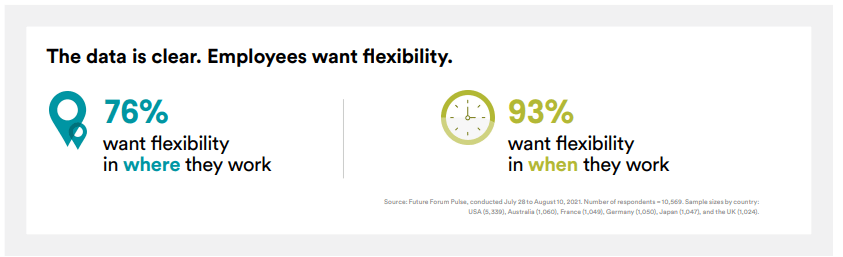
While decision-makers are busy finding the optimal balance in the plan to return to the office, employees are fighting employers to work where they want and when during the day. In the latest pulse survey, 76% of workers want flexibility in where they work. An overwhelmingly 93% want flexibility when they work. Employees currently allowed those two policies are twice as likely to report an improved work-related stress level. This survey response is compared to those working the standard “9-5” in an office.
Employees want flexibility in where and when they work. (Source: Future Forum Pulse Survey)
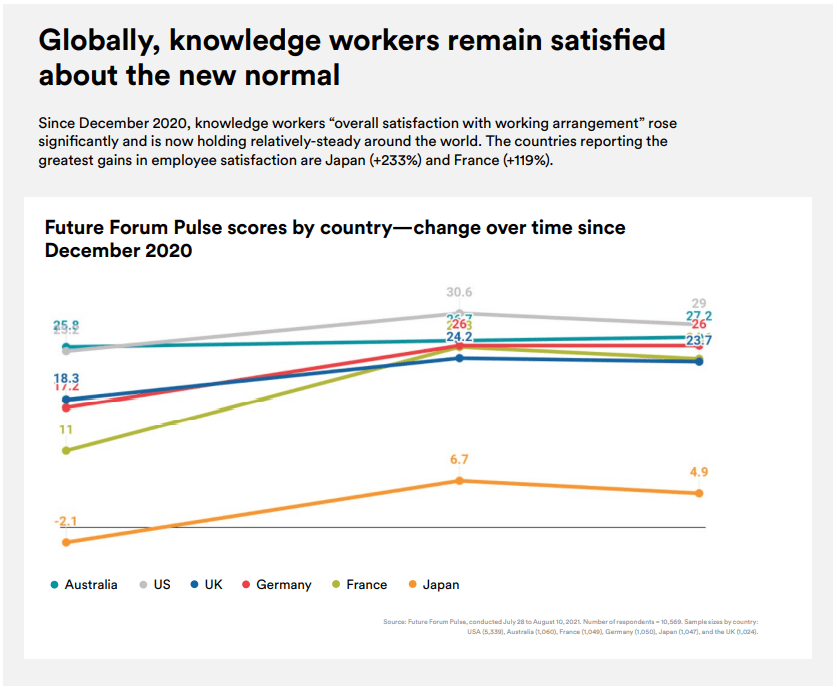
Furthermore, the data suggest that employees reported higher overall satisfaction with the new working environment as time in the virtual world increased. Future forum conducted a poll in December 2020 to see, by country, the level of satisfaction with working remotely. Two subsequent studies in July and August were done in 2021 to determine if there was an improvement or decline in overall satisfaction. What the survey found was that there was an increased satisfaction with the working environment, with the base satisfaction ranging from 11 (indifferent) to 25 (positive), centering out to around 25 (positive) in August 2021 for all countries except Japan. What this shows is that there is an adaptation to the new working environment. Now, there is hesitancy for those who have adapted to return to the workplace. The statistics show that employees do not want to return to the office and instead prefer to work when and where they can also fit their personal needs.
Future Forum Pulse scores by country – Change over time since December 2020
Employees are looking for the Company that best fits their values
All these points mentioned before add up to this final section. Unheard employees who are forced to go back to the office, feeling management’s inauthenticity and an unwillingness to accommodate them lead employees to either look for other jobs or exit the workforce altogether. Whether or not you think this trend is sustainable is not the point of this post. However, the future forum poll survey shows that 57% of all respondents report that they’re open to looking for new jobs in the next year. 63% of Americans lead the polls, with Australia not too far behind at 60%. Of the reasons mentioned for leaving, low satisfaction on the current flexibility of their job rose at the top (71% said they are open to new opportunities for this reason).
In comparison, 72% of workers say they will make the job switch if they have a low sense of belonging. This dual dilemma, in my opinion, is the difficulty that executives have to make within their workforce. On the one hand, if the companies don’t incorporate office work, the total team morale will decrease. If companies include too much work from the office, employees will feel that they do not have enough flexibility. This is truly one of the most challenging times for executives, and they will need to come to some compromise to satisfy both the needs of the corporation and the needs of the employees.
Final thoughts and conclusions
We are truly living in an unprecedented time where both corporations and employees need to come together to find a balancing act between work and life. As work becomes more of a digital and mentally demanding job and less of a physical one, employees are not tied down to one geographic location to do their job. There needs to be a culture maintained within the Company that traditionally was kept in place by the small breaks during work. Employers are encouraged to listen to the needs of their workers while also setting realistic expectations for their employees. Employees need to continue to prove that working from home is as effective as working from an office and take ownership in your work to keep the trust growing. I treat this new work environment to when employers first gave you tasks with minimal consequences and then, over time, gradually gave you more responsibility. It takes trust to enter a new work environment. Companies that trust their employees have embraced work from home based on my experience. Over time, other companies should follow if they have the same sentiment.
The opinions expressed herein are my own and do not represent my employer’s views in any way. Nothing posted here should be considered official or sanctioned by my employer or any other organization I’m affiliated with.
The statement of cash flows is one of the most challenging financials to understand. Fortunately, you can learn this area with enough practice. I wanted to introduce one of the more common items of the statement of cash flows, which is fixed assets. You’ll see this on almost every business’ financials as you generally need assets to make your product, advertise, sell, and maintain your records. First, let’s refresh our brains on recording fixed assets on the income statement and balance sheet. Then, we will discuss the standard movements in the cash flows as a company’s assets go from initial purchase to final disposal. Let’s get started.
How does an asset reflect in the income statement?
When a property, plant, and equipment is purchased and placed into service, the item depreciates over time to reflect the cost to use the asset. The asset will fully depreciate, in a perfect world,when the company cannot physically (or virtually) use it anymore. However, it is more practical to establish a time period for that asset based on a company-wide classification system. The company records depreciation as an expense (debit) for each period. Then, they record a second entry in the balance sheet as accumulated depreciation (credit).
How does an asset reflect in the balance sheet?
A company records an initial asset purchase as a reduction in cash (or an increase in liabilities if not paid outright) and an increase in the said asset. Regardless of how the PP&E was acquired, there will be an initial credit (i.e., credit to liabilities to increase the amount owed or a credit to recognize the reduction of cash). On the debit side of the transaction, the company records the asset on their balance sheet (i.e., a debit to Property, Plant, and Equipment). By doing this, your books will balance. For future periods, that newly acquired asset will then depreciate to recognize the cost incurred (This was discussed in the section “How does an asset reflect in the income statement”).
How does an asset reflect in the statement of Cash Flows?
Now that we’ve had a refresher on recognizing newly purchased assets on the income statement and the balance sheet, we can see how the entries recorded within these two financial statements intertwine with the statement of cash flows. As a reminder, the statement of cash flows is simply a reconciliation of movements within the balance sheet and income statement accounts for items that do not have a cash impact (within operating activities) and those with a cash impact within the investing and financing activities. A typical comparative period is the beginning of the fiscal year to the current period-end. If we know what the entries are within the balance sheet and the income statement, we can then figure out which entries actually have a cash impact and which ones do not have a cash impact to prepare the statement of cash flows. Let’s first start with recognizing the asset in the first place from a cash flows perspective.
The initial recording of property plant and equipment
As we saw in the balance sheet refresher section, recording property, plant, and equipment first requires recognizing a new asset for the purchase price incurred. If there was no cash expenditure, then recording the statement of cash flows is easy for this new asset. There is no recognition because the company did not pay anything. Once the company pays cash for the investment, the purchase is an expenditure in the investing activities. The accounts payable also decreases if there are payment terms for the purchase. Let’s assume that the company paid cash. Then, they recognize the cash outflow in the investing activities for the amount purchased. Therefore, the initial debit recognition in the balance sheet is also the initial cash outflow within the investing section of the statement of cash flows.
The recording of depreciation in subsequent periods within the cash flow statement
After recognizing the expenditure as an investing activity, it is interesting to note that you acknowledge depreciation as a non-cash expense within the operating activities. Therefore, the initial cash outflow in investing will be slowly reverting to a cash-neutral balance, assuming everything else is equal. Let’s illustrate an example. If initially, you spent $100 on a new storage facility for your business, you would recognize that asset in the statement of cash flows as a cash expenditure in the investing activities. All else being equal, you now have a net cash outflow of $100. Currently, the expenditure has worked against you from a cash flow perspective. However, the operating cash flow from the asset then starts working in your favor by amortizing the initial expenditure. Over time, the equipment begins appreciating within the cash flow and gives you an “increase” in cash each period until the depreciation fully reaches the $100 you initially spent. I intentionally put the increase in quotation marks because, as we saw earlier, there was an initial cash outflow of $100. Therefore, you do not recognize a tangible increase in cash (e.g., more money in your bank account); you are recovering the initial $100 cash outflow from the initial purchase. This movement ties with the income statement perspective because you initially don’t recognize the total expense within one period for making the purchase. Still, you increase the overall cost of operations in the income statement to record depreciation over time, compared to recognizing the expense at once. This movement suggests that the cash flow and income statement have a precisely opposite relationship regarding how and when the asset benefits and disadvantages you.
What happens after fully depreciating an asset?
With the income statement, once fully depreciated, there is no more expense to recognize. As a result, there is no further recognition within the cash flow as well. As you can see, this implies that there is a relationship between the income statement in the statement of cash flows. As a matter of fact, during a financial statement review, it is standard practice for an auditor to gain comfort over the depreciation expense by tying it to the trial balance. If there is no depreciation expense, then there is no change in the statement of cash flows. Since there are no future entries towards the balance sheet or the income statement once the asset is fully appreciated, there is nothing else to do in the cash flow statement.
What happens to the asset after disposing of it for cash?
When disposing of an asset, the investing and operating activities are involved. If the company sells an investment higher (lower) than its net book value, they recognize a gain (loss) within the income statement. Since it is not incremental cash recognition, the company will only record the money received (in investing) while the gain (loss) decreases (increases) operating activities. This movement in the cash flow makes sense because, in the income statement, you recognize the gain that causes a boost within your total net income or loss. Since this is not an actual movement in cash, the gain (loss) needs to be excluded from the cash flows. Furthermore, you also have to reverse the accumulated depreciation balance for the net book value. Since depreciation initially gave you a benefit in the cash flow statement, it will decrease cash when clearing the accumulated depreciation. However, you are now also recognizing an increase in money from the disposal of your asset.
In summary, the asset removal in the balance sheet ties with the movement in the cash flow as follows. The balance sheet increases with the clearing of the accumulated depreciation and thus shows an outflow one-to-one in the operating section of the cash flows. The clearing of the asset is more involved. Clearing the asset sold lowers the balance sheet (the opposite expectation of the accumulated depreciation). Therefore, we expect the cash inflow to be positive in the investing activity. But wait! There is probably a difference between the dollar value of the disposal and the dollar amount received. The difference lies in the gain (loss) that in the operating activities. As you can see, disposals are more involved but can be understood when piecing the movements logically.
The opinions expressed herein are my own and do not represent my employer’s views in any way. Nothing posted here should be considered official or sanctioned by my employer or any other organization I’m affiliated with.
 Students, Accountants, and Business Owners (SAB)